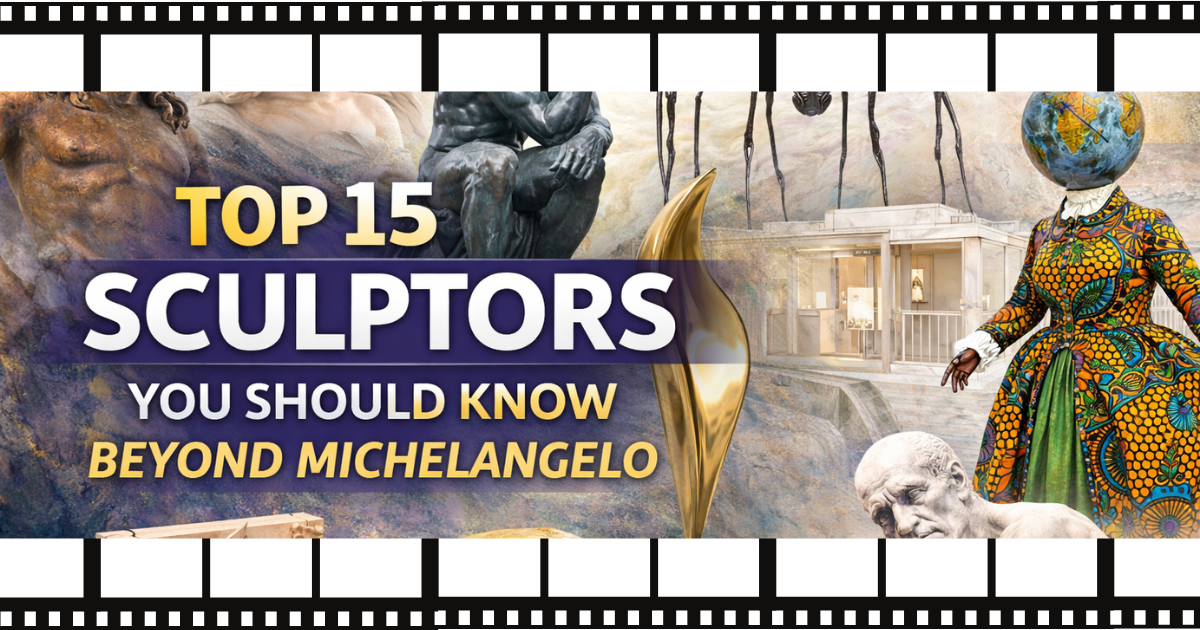
Michelangelo is often the universal shorthand for sculptural genius, but the medium spans far beyond the Renaissance master’s marble perfection. The world of three-dimensional art is vast, global, and constantly evolving. For filmmakers, set designers, casting professionals, and creative artists, expanding your visual vocabulary is essential.
Here are the Top 15 Sculptors You Should Know Beyond Michelangelo at a glance:
- Donatello: An early Renaissance pioneer who revived classical naturalism in bronze.
- Gian Lorenzo Bernini: The master of Baroque, turning marble into flesh through theatrical drama.
- Auguste Rodin: The father of modern sculpture, known for textured, expressive surfaces.
- Constantin Brâncuși: A modernist who stripped subjects down to their absolute, elegant essence.
- Alberto Giacometti: Famous for elongated, fragile figures that capture post-war existentialism.
- Henry Moore: Integrated massive, abstract human forms with the sweeping contours of nature.
- Louise Bourgeois: Pioneered deeply psychological, confessional installations and giant spiders.
- Barbara Hepworth: Introduced the “hole” (negative space) as a vital, active component of sculpture.
- Isamu Noguchi: Erased boundaries between fine art, landscape architecture, and practical design.
- Käthe Kollwitz: Used sculpture as a vehicle for profound empathy and pacifist commentary.
- Niki de Saint Phalle: Reclaimed the female form with joyous, colorful, larger-than-life mosaics.
- Anish Kapoor: Manipulates highly reflective surfaces and absolute voids to distort reality.
- Maya Lin: Redefined the monument by integrating quiet, minimalist reflection into the earth.
- Rachel Whiteread: Casts the empty, negative spaces of domestic objects to solidify memory.
- Yinka Shonibare: Uses vibrant textiles to create post-colonial tableaux that question history.
Studying these artists provides incredible blueprints for lighting, framing, texture, and emotional resonance. Let’s dive into why each of these visionaries matters to your creative practice.
1. Donatello (The Naturalist Pioneer)
Born in Florence during the early Renaissance, Donatello (c. 1386–1466) broke away from rigid Gothic traditions to revive classical antiquity’s naturalism. He mastered multiple mediums, from wood and marble to bronze.
Signature Works: His bronze David is the first free-standing nude statue since antiquity, radiating quiet confidence. His Equestrian Monument of Gattamelata set the standard for monumental bronze casting.
Cultural Significance: Donatello reintroduced contrapposto (an asymmetrical arrangement of the human figure) and pioneered rilievo schiacciato, a technique of incredibly shallow relief carving that creates a brilliant illusion of deep space.
Where to see his work: The Bargello National Museum, Florence.
Why this matters to creators: His mastery of shallow relief teaches filmmakers and cinematographers how to imply infinite depth and distance within flat, compressed visual frames.
2. Gian Lorenzo Bernini (The Baroque Dramatist)
Gian Lorenzo Bernini (1598–1680) was the architect of 17th-century Rome and the undisputed master of the Baroque style. He treated marble as though it were pliable clay.
Signature Works: Apollo and Daphne, capturing the exact moment a nymph transforms into a tree, and The Ecstasy of Saint Teresa, an immersive installation of spiritual rapture.
Cultural Significance: Bernini didn’t just carve figures; he directed scenes. He pioneered the concept of the bel composto, unifying sculpture, painting, and architecture into one deeply theatrical, emotional experience designed to overwhelm the viewer.
Where to see his work: Galleria Borghese, Rome; St. Peter’s Basilica, Vatican City.
Why this matters to creators: Bernini’s use of hidden windows to cast divine, directional light onto his sculptures is a historical masterclass for cinematographers lighting emotional peaks.
3. Auguste Rodin (The Modern Expressive)
Auguste Rodin (1840–1917) is widely considered the progenitor of modern sculpture. The French artist violently broke away from the polished, idealized academic traditions of his era.
Signature Works: The Thinker and his lifelong, unfinished masterwork, The Gates of Hell.
Cultural Significance: Rodin celebrated the raw, unfinished textures of clay and bronze. He left tool marks visible, emphasizing the physical labour of creation and the turbulent, internal psychology of his subjects rather than their outward perfection.
Where to see his work: Musee Rodin, Paris; Rodin Museum, Philadelphia.
Why this matters to creators: The interplay of rough textures and harsh lighting on his bronzes provides deep inspiration for gritty character makeup and atmospheric production design.
4. Constantin Brancusi (The Essentialist)
Romanian-born Constantin Brancusi (1876–1957) moved to Paris and revolutionized sculpture by walking away from realism entirely, seeking what he called “the essence of things.”
Signature Works: Bird in Space, a sleek, aerodynamic form that captures the feeling of flight rather than the anatomy of a bird, and The Kiss.
Cultural Significance: Brancusi pioneered modernist abstraction. By polishing bronze and marble to a mirror finish and reducing forms to pure geometry, he influenced decades of minimalist art and industrial design.
Where to see his work: Centre Pompidou, Paris; Philadelphia Museum of Art.
Why this matters to creators: Brancusi teaches the power of extreme reduction; filmmakers can learn how simple, elegant, uncluttered silhouettes can command an entire cinematic frame.
5. Alberto Giacometti (The Existential Observer)
Swiss sculptor Alberto Giacometti (1901–1966) created some of the most recognizable silhouettes of the 20th century, heavily influenced by the trauma of World War II and the philosophy of existentialism.
Signature Works: Walking Man I and Pointing Man, impossibly thin, skeletal bronze figures with heavily scarred, pitted surfaces.
Cultural Significance: Giacometti captured the isolation, fragility, and resilience of the modern human condition. His figures look as though they have been eroded by space itself, appearing distant even when viewed up close.
Where to see his work: Kunsthaus Zürich; The Museum of Modern Art (MoMA), New York.
Why this matters to creators: His elongated, skeletal proportions offer profound visual cues for casting and designing otherworldly, haunted, or psychologically burdened characters.
Visual Guide: Key Sculptural Elements Filmmakers Should Notice
When visiting a museum for inspiration, stop looking at what the sculpture is, and analyze how it operates:
- Silhouette: Does the outline of the shape read clearly against the background? (Crucial for character blocking).
- Negative Space: How does the artist use the empty air around or inside the piece?
- Texture & Patina: How does light catch on rough bronze vs. polished marble? (Informs set dressing and costume materials).
- Scale & Site-Specificity: How does the size of the piece alter the viewer’s physical behaviour in the room?
6. Henry Moore (The Landscape Integrator)
Henry Moore (1898–1986) was a British artist who became globally famous for his monumental, semi-abstract bronze and marble sculptures, which are installed in public spaces worldwide.
Signature Works: His massive Reclining Figures, which often resemble rolling hills, caves, or eroded bone as much as they do human bodies.
Cultural Significance: Moore championed the idea that sculpture should not be confined to galleries. He seamlessly integrated the undulating, abstract human form with the sweeping contours of the natural landscape.
Where to see his work: Yorkshire Sculpture Park, UK; Henry Moore Foundation, Perry Green.
Why this matters to creators: Studying Moore shows production designers how to naturally integrate massive props or architectural set pieces harmoniously into outdoor, natural locations.
7. Louise Bourgeois (The Psychological Architect)
French-American artist Louise Bourgeois (1911–2010) used her art to process childhood trauma, pioneering confessional and feminist installation art.
Signature Works: Maman (a 30-foot-tall bronze spider representing the protective, weaving nature of her mother) and her Cells (cage-like architectural installations).
Cultural Significance: Bourgeois was fearless in combining unusual materials, fabric, old clothing, steel, and salvaged doors, to map the landscape of human anxiety, memory, and sexuality.
Where to see her work: Tate Modern, London; Guggenheim Museum Bilbao.
Why this matters to creators: Her enclosed, intensely curated Cells offer brilliant, eerie blueprints for designing claustrophobic, character-driven set pieces and interior environments.
8. Barbara Hepworth (The Master of the Void)
A contemporary of Henry Moore, British modernist Barbara Hepworth (1903–1975) was a leading figure in the international art scene, known for her smooth, organic abstractions.
Signature Works: Single Form (at the UN Headquarters) and Pelagos, featuring taut strings stretching across hollowed-out wooden curves.
Cultural Significance: Hepworth is credited with introducing the “hole” into British sculpture. She treated negative space not as an absence, but as a vital, active component with equal weight to the solid mass.
Where to see her work: The Barbara Hepworth Museum and Sculpture Garden, St Ives; Tate Britain.
Why this matters to creators: She provides a masterclass in framing; filmmakers can learn to shoot subjects through foreground apertures and utilize negative space to balance cinematic compositions.
9. Isamu Noguchi (The Holistic Designer)
Isamu Noguchi (1904–1988) was a Japanese-American artist who refused to recognize the boundary between fine art and practical, functional design.
Signature Works: The iconic Akari light sculptures (paper lanterns), the Red Cube in Manhattan, and vast sculptural playgrounds.
Cultural Significance: Noguchi believed that everything was sculpture. He designed furniture, public parks, theater sets (notably for Martha Graham), and gardens, treating the entire human environment as a canvas for spatial harmony.
Where to see his work: The Noguchi Museum, Queens, New York; various global public plazas.
Why this matters to creators: His holistic approach to space and practical lighting design is invaluable for art directors aiming for cohesive, atmospheric production design.
10. Käthe Kollwitz (The Empathetic Realist)
Käthe Kollwitz (1867–1945) was a German artist who captured the plight of the working class and the devastating tragedy of war through printmaking and sculpture.
Signature Works: Mother with her Dead Son (a haunting, enlarged Pietà-like figure).
Cultural Significance: Kollwitz stripped away all heroic, romanticized notions of war. Her sculptures are vehicles for profound empathy, using heavy, grounded, grieving forms to deliver powerful pacifist and social commentary.
Where to see her work: The Neue Wache, Berlin; Käthe Kollwitz Museum, Cologne.
Why this matters to creators: Her work demonstrates how unglamorous, heavy physical postures and body language can convey immense, silent emotional weight on screen.
Quick Exercise: 3 Ways to Translate a Sculpture into a Shot
- Camera Angle: View the sculpture from an extreme low angle. Notice how it becomes imposing. Use this angle to give your actors an aura of monumental power.
- Depth of Field: Focus closely on the rough texture of the sculpture while letting the background blur, mimicking how a macro-lens captures character details and costume wear.
- Lighting: Move a single flashlight (or phone light) slowly around the sculpture. Watch how shifting shadows completely alter the “mood” of the inanimate face.
11. Niki de Saint Phalle (The Joyous Monumentalist)
French-American artist Niki de Saint Phalle (1930–2002) was a self-taught sculptor who initially gained fame by shooting paint-filled balloons with a rifle, before turning to joyous monumental works.
Signature Works: Her Nanas, massive, brightly painted, voluptuous female figures, and the sprawling, architectural Tarot Garden in Tuscany.
Cultural Significance: In an era of stark minimalism, Saint Phalle reclaimed the female body with unapologetic joy, vibrant color, and playful scale, turning public art into an interactive, mythical wonderland.
Where to see her work: The Tarot Garden, Tuscany, Italy; Stravinsky Fountain, Paris.
Why this matters to creators: Her fearless use of mosaic color palettes and hyper-exaggerated curves can inspire vibrant, fantastical costume design and surreal world-building.
12. Anish Kapoor (The Illusionist of Form)
Sir Anish Kapoor (b. 1954) is a British-Indian contemporary sculptor whose work frequently blurs the line between object and optical illusion.
Signature Works: Cloud Gate (affectionately known as “The Bean” in Chicago) and Descension, a terrifying, endless vortex of black water.
Cultural Significance: Kapoor uses highly engineered materials, from flawless mirrored steel to Vantablack (the darkest substance known to man),to distort space, making massive objects seem weightless or turning solid ground into terrifying voids.
Where to see his work: Millennium Park, Chicago; various rotating global exhibitions.
Why this matters to creators: Manipulating highly reflective surfaces or absolute darkness on set can warp a viewer’s sense of scale and reality, creating spectacular in-camera visual effects.
13. Maya Lin (The Environmental Memorialist)
Maya Lin (b. 1959) catapulted to fame as a 21-year-old Yale architecture student when she won the design competition for the Vietnam Veterans Memorial.
Signature Works: Vietnam Veterans Memorial and Wave Field, where she sculpted the earth itself into rolling, rhythmic waves of grass.
Cultural Significance: Lin completely redefined the concept of the public monument. Instead of erecting heroic, vertical statues on pedestals, she creates horizontal, minimalist cuts into the earth that foster intimate, quiet reflection.
Where to see her work: National Mall, Washington D.C.; Storm King Art Center, New York.
Why this matters to creators: Lin highlights the emotional impact of minimalist design; integrating sets directly into the natural topography can be more powerful than building above it.
14. Rachel Whiteread (The Caster of Memories)
British artist Rachel Whiteread (b. 1963) makes the invisible visible. She is renowned for casting the negative spaces inside and around everyday objects.
Signature Works: Ghost (the plaster cast of the inside of a Victorian living room) and the Juden Platz Holocaust Memorial (a concrete cast of an inverted library).
Cultural Significance: By solidifying the empty air beneath a chair, inside a hot water bottle, or within an entire condemned house, Whiteread turns absence into presence, creating profound monuments to domestic memory and loss.
Where to see her work: Tate Britain, London; Juden Platz, Vienna.
Why this matters to creators: The concept of “negative space” is a profound tool for visual storytelling, allowing directors to emphasize what is lost, absent, or unspoken in a scene.
15. Yinka Shonibare (The Post-Colonial Provocateur)
British-Nigerian artist Yinka Shonibare CBE (b. 1962) creates visually lush, conceptually sharp sculptures that interrogate race, class, and global trade.
Signature Works: Nelson’s Ship in a Bottle and his series of headless, life-sized mannequins posed in classical European scenes, dressed in vibrant Dutch wax fabrics.
Cultural Significance: Shonibare uses these brightly coloured, “African” textiles, which are actually Indonesian-inspired and historically manufactured in Europe, to expose the tangled, often violent histories of colonialism and cultural appropriation.
Where to see his work: National Museum of African Art, Washington D.C.; various global contemporary galleries.
Why this matters to creators: Subverting expected classical or period silhouettes with anachronistic, culturally charged textiles provides costume designers a powerful way to deliver silent narrative commentary.
Conclusion
Understanding the Top 15 Sculptors You Should Know Beyond Michelangelo gives you an entirely new toolkit for visual storytelling. Sculpture is the art of manipulating space, light, and mass, the exact same elements required to block a scene, design a set, or light an actor.
By looking at the emotional surfaces of Rodin, the existential silhouettes of Giacometti, or the spatial illusions of Kapoor, you train your eye to see beyond the flat screen. To implement these lessons, we highly recommend visiting your local art museum. Take close-up photos of patinas and textures, study the negative space around the installations, and add these master sculptors to your mood-boards for your next creative project.