Classical music is not a relic. It is the structural foundation beneath film scores, the reference point for every conservatory-trained performer, and the cultural language that connects centuries of human emotion to modern storytelling. When a period drama needs authenticity, when a casting director seeks a trained opera singer, or when a filmmaker builds a scene around tension and release, they reach for the vocabulary that these fifteen musicians built.
This guide serves new listeners who want a reliable entry point, working performers who need to understand their artistic lineage, and casting and production professionals who require contextual fluency in classical repertoire. You will find concise biographies, signature contributions, recommended works, and practical notes for anyone working at the intersection of music and performance.
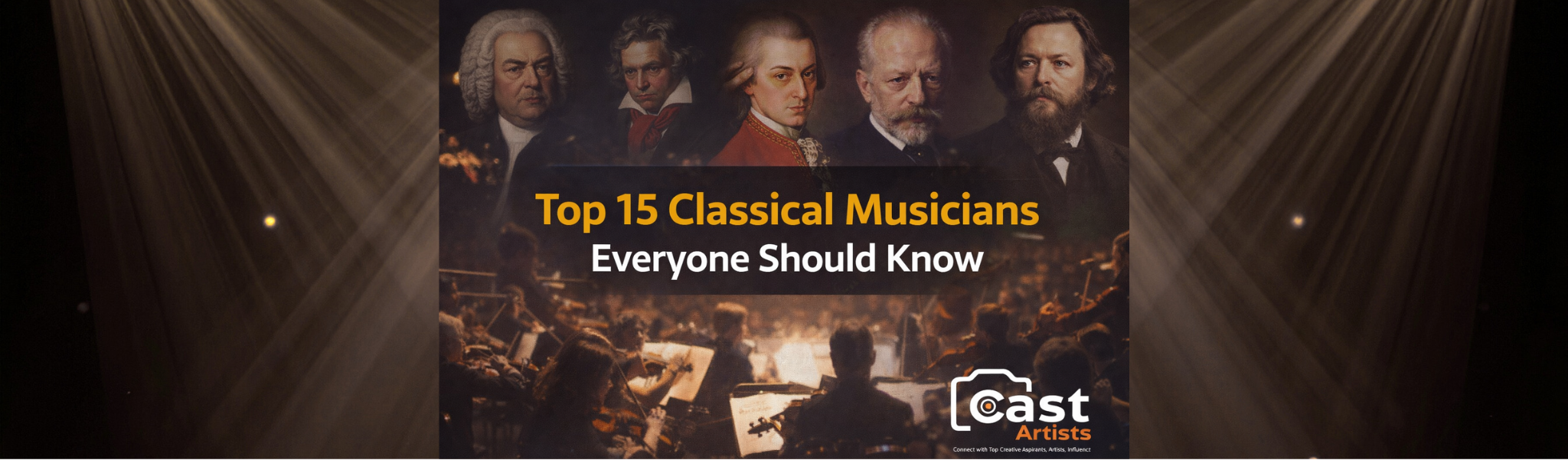
The top 15 classical musicians everyone should know span four centuries, multiple nationalities, and every major musical era , from Baroque counterpoint to twentieth-century modernism. Start anywhere. Follow your curiosity. The music will do the rest.
- Johann Sebastian Bach, the architect of Western musical structure
- Ludwig van Beethoven, the bridge between Classical order and Romantic passion
- Wolfgang Amadeus Mozart, the most naturally gifted melodist in music history
- Frédéric Chopin, the poet of the piano and master of lyrical Romanticism
- Pyotr Ilyich Tchaikovsky, the composer who gave ballet its emotional vocabulary
- Giuseppe Verdi, the defining voice of Italian Romantic opera
- Richard Wagner, the revolutionary who transformed opera into total dramatic experience
- Claude Debussy, the Impressionist who dissolved melody into atmosphere
- Igor Stravinsky, the modernist who reinvented rhythm and theatrical music
- Dmitri Shostakovich, the Soviet-era symphonist who hid defiance in plain sight
- Antonio Vivaldi, the Baroque master of the concerto form
- Johannes Brahms, the Classical traditionalist who defined late Romantic depth
- Clara Schumann, the most important female composer-performer of the nineteenth century
- Maria Callas, the soprano who redefined operatic expression for the modern era
- Leonard Bernstein, conductor, composer, and the twentieth century’s greatest musical ambassador
1. Johann Sebastian Bach (1685–1750)
Johann Sebastian Bach, German, Baroque. Bach was a church organist and court composer who spent his career producing music for Lutheran services, royal courts, and personal devotion. He was not widely famous in his own lifetime, his rehabilitation came nearly a century after his death, when composers including Mendelssohn recognized the magnitude of what he had built.
Bach codified the rules of counterpoint, multiple independent melodic lines woven into structural perfection, that every trained musician still studies today. His work is simultaneously mathematical and deeply emotional.
Listen first: The Well-Tempered Clavier, Book I and St. Matthew Passion. The former demonstrates harmonic architecture at its clearest; the latter is one of the most moving choral works ever written.
Casting note: Essential for any production set in Baroque Europe, Lutheran church settings, or depicting the world of J.S. Bach himself, the 2023 series Baroque Intrigue used his chorale settings throughout.
Recommended recording: András Schiff’s ECM recording of The Well-Tempered Clavier is widely considered the benchmark modern interpretation.
2. Ludwig van Beethoven (1770–1827)
Ludwig van Beethoven, German, Classical/Romantic. Beethoven studied under Haydn in Vienna and quickly established himself as the most formidable pianist and composer of his generation. His progressive hearing loss, which became total deafness by his mid-forties, did not slow his output; his late works are considered his most profound.
Beethoven expanded every musical form he touched, the symphony, the string quartet, the piano sonata, and established the Romantic idea that music could express the full range of human experience, not merely elegant entertainment.
Listen first: Symphony No. 5 in C minor and Piano Sonata No. 14 “Moonlight”. The Fifth announces his dramatic voice immediately; the Moonlight Sonata demonstrates his lyrical intimacy.
Casting note: Universally recognized, his music signals heroism, struggle, and transcendence in film and drama; widely licensed for cinematic use.
3. Wolfgang Amadeus Mozart (1756–1791)
Wolfgang Amadeus Mozart, Austrian, Classical. Mozart was composing minuets at five and performing for European royalty at six. His adult career produced 41 symphonies, 27 piano concertos, and some of the most beloved operas ever written, all by the time of his death at 35.
Mozart’s gift was melodic invention of apparently effortless grace. He wrote music that sounds simple but is fiendishly difficult to perform with the clarity it demands, a quality that separates trained performers from technically proficient ones.
Listen first: Symphony No. 40 in G minor and The Marriage of Figaro. The symphony shows his structural mastery; the opera reveals his unmatched ability to characterize human behavior through music.
Casting note: Ideal for productions set in the Viennese Classical period; his operas are the first audition standard for many classical vocal roles.
Recommended recording: Karl Böhm’s Deutsche Grammophon recording of the final symphonies remains a foundational reference.
4. Frédéric Chopin (1810–1849)
Frédéric Chopin, Polish-French, Romantic. Chopin spent most of his adult life in Paris, where he became the preferred composer-pianist of the French aristocracy and salon society. He composed almost exclusively for solo piano, a narrow focus that produced one of the most comprehensive and influential bodies of work the instrument has ever received.
Chopin transformed the piano from a drawing-room instrument into a vehicle for deep psychological expression. His innovations in pedaling, phrasing, and harmonic color influenced every subsequent composer who wrote for the piano.
Listen first: Ballade No. 1 in G minor and the Nocturnes (Op. 9). The Ballade is dramatic and narrative; the Nocturnes are intimate, introspective, and immediately accessible.
Casting note: His music is the standard period reference for Romantic salon scenes, Polish cultural identity in drama, and classical piano recitals in any production context.
5. Pyotr Ilyich Tchaikovsky (1840–1893)
Pyotr Ilyich Tchaikovsky, Russian, Romantic. Tchaikovsky was the first Russian composer to achieve sustained international fame during his own lifetime. He worked across orchestral, operatic, and chamber forms but built his most enduring legacy in ballet, a genre he essentially reinvented as a vehicle for symphonic ambition.
Tchaikovsky gave ballet a musical seriousness it had never previously commanded. His orchestral writing is characterized by sweeping emotional intensity, unforgettable melody, and an ability to depict character and narrative through purely instrumental means.
Listen first: Swan Lake and Symphony No. 6 “Pathétique”. Swan Lake is his most iconic theatrical score; the Pathétique is his most personally revelatory symphonic work.
Casting note: Indispensable for any production involving ballet, Russian Imperial setting, or nineteenth-century aristocratic drama.
Recommended recording: Valery Gergiev’s Mariinsky Orchestra recording of the three great ballets is considered definitive in modern performance.
6. Giuseppe Verdi (1813–1901)
Giuseppe Verdi, Italian, Romantic. Verdi dominated Italian opera for fifty years, producing a body of work that stretched from the melodramatic energy of his early operas to the psychological complexity of his late masterpieces. He was also a symbol of Italian national identity, his name became shorthand for the Risorgimento independence movement.
Verdi’s operas are the foundation of the dramatic soprano, mezzo-soprano, baritone, and tenor repertoire. No singer working in opera today avoids his demands, his vocal writing is simultaneously grateful and exhausting.
Listen first: La Traviata and Otello. La Traviata is the accessible emotional entry point; Otello represents his late, psychologically mature style at its peak.
Casting note: The standard reference for Italian opera casting; his heroines (Violetta, Aida, Desdemona) are the benchmark dramatic soprano roles.
7. Richard Wagner (1813–1883)
Richard Wagner, German, Romantic. Wagner was composer, librettist, conductor, and relentless self-promoter, he designed and built his own festival theater at Bayreuth specifically to stage his works on his own terms. His operas, which he called “music dramas,” were conceived as total artworks integrating music, poetry, drama, and visual spectacle.
Wagner invented the leitmotif as a dramatic tool, a recurring musical theme associated with a specific character, object, or idea, a technique that became the primary structural method of film scoring and has never stopped being used.
Listen first: The Ring of the Nibelung (start with Das Rheingold) and the Prelude to Tristan und Isolde. The Ring is the most ambitious work in the operatic repertoire; the Tristan Prelude is the most influential single piece in the history of Western harmony.
Casting note: Wagnerian singers are a specific vocal category, casting for his roles requires specialist knowledge of Heldentenor and dramatic soprano voice types.
8. Claude Debussy (1862–1918)
Claude Debussy, French, Impressionist. Debussy rejected the Germanic structural traditions that dominated European music in the late nineteenth century and developed a personal harmonic language drawn from French symbolist poetry, Japanese court music, and the whole-tone scale. His work sounds like no one else before him.
Debussy dissolved the boundaries between melody, harmony, and color in ways that made him the direct ancestor of ambient music, jazz harmony, and modern film scoring. Nearly every film composer working with impressionistic texture owes him an acknowledged debt.
Listen first: Clair de lune (from Suite bergamasque) and La Mer. Clair de lune is the most immediate entry point to his voice; La Mer demonstrates his full orchestral ambition.
Casting note: Essential atmospheric reference for French Belle Époque settings and early twentieth-century European period drama.
Recommended recording: Pierre Boulez’s Deutsche Grammophon recording of La Mer and the orchestral Images is the modern benchmark.
9. Igor Stravinsky (1882–1971)
Igor Stravinsky, Russian-American, Modernist. Stravinsky’s career spans more than sixty years and three distinct stylistic periods, Russian nationalism, Neo-classicism, and Serialism, making him the most stylistically adaptable major composer of the twentieth century. His early ballets for Sergei Diaghilev’s Ballets Russes changed the course of modern music.
The Rite of Spring (1913) provoked a riot at its Paris premiere and effectively announced the arrival of modernism, its rhythmic complexity and harmonic dissonance remain a reference point for anyone studying twentieth-century composition or contemporary choreography.
Listen first: The Rite of Spring and The Firebird. The Firebird is the accessible, brilliant starting point; The Rite of Spring is the challenge that rewards repeated listening.
Casting note: His ballet scores are live performance staples, knowledge of his work is essential for contemporary dance and theatrical production professionals.
10. Dmitri Shostakovich (1906–1975)
Dmitri Shostakovich, Russian, Modernist. Shostakovich spent his career navigating the demands of the Soviet state, twice publicly denounced under Stalin, repeatedly forced to recant and conform, while producing music that serious listeners recognized as coded resistance. The tension between public compliance and private truth defines his voice.
Shostakovich’s symphonies and string quartets represent the most sustained engagement with political repression in the Western musical canon. His music is darkly sardonic, emotionally direct, and structurally innovative, a unique combination that makes him essential listening for anyone serious about twentieth-century music.
Listen first: Symphony No. 5 in D minor and String Quartet No. 8. The Fifth was publicly presented as redemption after Soviet criticism; the Eighth is a shattering personal document composed in three days.
Casting note: Ideal for productions set in Soviet Russia or depicting Cold War-era Eastern Europe, his music carries the historical weight of that world.
11. Antonio Vivaldi (1678–1741)
Antonio Vivaldi, Italian, Baroque. Vivaldi was a virtuoso violinist and prolific composer who worked primarily as a music teacher at an orphanage for girls in Venice, a position that gave him a dedicated ensemble for which he produced hundreds of concertos. He composed more than 500 concertos in his lifetime, of which nearly half survive.
Vivaldi essentially standardized the three-movement concerto form (fast-slow-fast) that remains the template for the genre today. He demonstrated that instrumental music could be as expressive and dramatic as vocal music, a fundamental shift in musical thinking.
Listen first: The Four Seasons. These four violin concertos are among the most performed and recognized pieces in the entire classical repertoire, each depicts a season in extraordinary instrumental detail.
Casting note: Universally recognized for Baroque period settings; The Four Seasons is among the most licensed classical works in advertising, film, and television.
12. Johannes Brahms (1833–1897)
Johannes Brahms, German, Romantic. Brahms was the great traditionalist of the Romantic era, he refused to embrace the operatic innovations of Wagner or the programmatic experiments of Liszt, insisting instead on the structural rigor of the Classical masters while filling those forms with Romantic emotional depth. He waited until he was forty-three to publish his First Symphony.
Brahms resolved the apparent contradiction between Classical structure and Romantic expression. His four symphonies are the direct successors of Beethoven’s and the direct ancestors of Mahler’s, the essential link in the orchestral tradition.
Listen first: Symphony No. 1 in C minor and Intermezzo in A major, Op. 118, No. 2. The symphony is monumental and emotionally complex; the Intermezzo is intimate and immediately beautiful.
Casting note: His lieder (art songs) are the standard repertoire for classical baritone and mezzo-soprano concert programs.
Recommended recording: Carlos Kleiber’s Vienna Philharmonic recording of the Fourth Symphony is among the most celebrated orchestral recordings of the twentieth century.
13. Clara Schumann (1819–1896)
Clara Schumann, German, Romantic. Clara Schumann was the most celebrated concert pianist in Europe during the mid-nineteenth century, a performing career that spanned six decades and brought the Romantic piano repertoire to concert halls across the continent. She was also a composer, a teacher of exceptional influence, and the woman primarily responsible for establishing Robert Schumann’s legacy after his death.
Why she matters: Clara Schumann broke the accepted limits of what a female musician could professionally achieve in nineteenth-century Europe and did so entirely through the quality of her artistry. Her compositional voice, lyrical, harmonically adventurous, was suppressed by both the era’s gender expectations and her own self-doubt, making her music a subject of significant modern rediscovery.
Listen first: Piano Concerto in A minor, Op. 7 and Three Romances, Op. 22. The concerto, written when she was sixteen, is astonishing in its ambition; the Romances reveal her gift for intimate melodic invention.
Casting note: Essential context for any production addressing nineteenth-century women in the arts, the Schumann household, or the relationship between Brahms and Robert Schumann.
14. Maria Callas (1923–1977)
Maria Callas, Greek-American soprano, twentieth century. Callas transformed the way opera is performed and understood. She brought an actor’s psychological intelligence to the operatic stage at a time when the form was dominated by vocal display over dramatic authenticity, and her interpretation of bel canto heroines (particularly Bellini and Donizetti roles that had fallen out of fashion) sparked an entire revival movement.
Why she matters: Callas established the standard against which every dramatic soprano is still measured. Her voice was not conventionally perfect, but its expressive range, color, and intensity defined what operatic acting could be. Her recordings remain primary listening for any singer serious about the repertoire.
Listen first: Casta diva from Norma and Vissi d’arte from Tosca. The former is her most iconic recording; the latter shows her interpretive intelligence at its most piercing.
Casting note: The benchmark reference for casting dramatic soprano roles, her name alone communicates a standard of combined vocal and dramatic achievement.
15. Leonard Bernstein (1918–1990)
Leonard Bernstein, American, twentieth century. Bernstein was simultaneously the Music Director of the New York Philharmonic, a prolific composer working across concert music and Broadway, and the most gifted musical educator American television ever produced. His Young People’s Concerts broadcast classical music to a generation that had never previously heard it explained with this combination of rigor and joy.
Bernstein collapsed the artificial division between “serious” and “popular” music with the authority of someone who was genuinely excellent at both. West Side Story remains the most performed American musical work internationally; his symphonies and the Chichester Psalms demonstrate his gifts in absolute music.
Conclusion
These fifteen musicians built the architecture of Western musical culture. Their works are not museum pieces, they are living documents performed in concert halls, recorded by new artists, and streamed millions of times daily. For performers, understanding this lineage deepens interpretive intelligence. For casting and production professionals, it provides the vocabulary to work with musical material accurately and with confidence.
The best entry point is always the music itself. Pick one name from this guide, find a recommended piece, and listen actively. The rest follows naturally. Cast Artists is here to connect the professionals who carry this tradition forward with the projects that need them most.